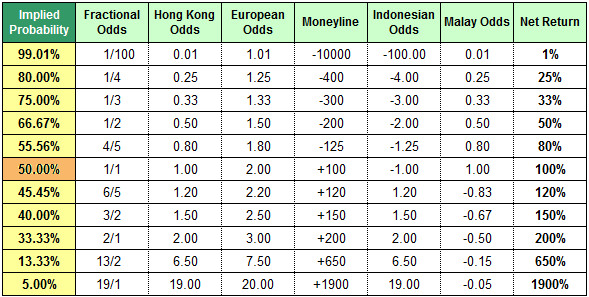
Understanding Decimal, Fractional, and Moneyline Odds: A Comprehensive Guide
When it comes to betting, understanding odds is crucial for making informed decisions. There are three primary formats used in sports betting: decimal odds, fractional odds, and moneyline odds. Each format presents the same information but caters to different audiences and preferences. Decimal odds, commonly used in Europe, represent the total payout rather than just the profit. For instance, a bet with decimal odds of 3.00 means that for every dollar wagered, a total of $3 would be returned if the bet is successful—including the original stake.
Fractional odds, often seen in the UK, display odds as a fraction, indicating the profit relative to the stake. For example, fractional odds of 5/2 suggest that for every $2 wagered, $5 would be made in profit. On the other hand, moneyline odds, popular among American bettors, can be either positive or negative. Positive moneyline odds indicate potential profit on a $100 bet, while negative odds illustrate how much one must wager to win $100. Understanding these formats allows bettors to make strategic choices and maximize their potential returns.
If you're looking to enhance your gaming experience, be sure to check out the latest duel promo code that offers exciting rewards and bonuses for new players.
How to Calculate Payouts with Different Odds Formats
Calculating payouts in sports betting can be complex due to the different odds formats used across various platforms. The three primary formats you’ll encounter are fractional, decimal, and moneyline odds. To calculate your potential payout, start by identifying the odds format you are working with. For fractional odds, such as 5/1, you simply multiply your stake by the numerator (5) and then add your original stake back in. So, a $10 bet at 5/1 would yield a total payout of $60, which includes the initial stake plus the profit.
In contrast, decimal odds provide a straightforward method as they already incorporate the initial stake into the calculation. For example, if the decimal odds are 6.0 and you bet $10, you would multiply your stake by the odds (10 x 6.0 = $60), thus receiving a payout of $60. Meanwhile, moneyline odds can be a bit trickier but are equally essential for calculating payouts. Positive moneyline odds, like +500, indicate how much profit you’d make on a $100 bet, thus a $10 wager would yield a $50 profit plus your stake back. Negative moneyline odds work in reverse, where you need to bet $100 to make a specific profit.
What Every Beginner Needs to Know About Betting Odds
Understanding betting odds is crucial for anyone looking to get started in the world of sports betting. Betting odds represent the probability of a particular outcome occurring, and they dictate how much money you can win if your bet is successful. Odds can be presented in different formats, including decimal, fractional, and moneyline. For beginners, it’s essential to familiarize yourself with these formats as they can affect your potential payouts significantly. For instance, decimal odds are straightforward; simply multiply your stake by the decimal number to see your total return. In contrast, fractional odds indicate your profit relative to your stake, while moneyline odds show how much you need to bet to win a certain amount, or how much you can win on a stake of a certain size.
When placing a bet, always keep in mind the concept of value. This means looking for bets where the odds offered are higher than the actual probability of the outcome occurring. For example, if you believe a team has a 60% chance of winning, but the odds imply only a 50% probability, there is value in betting on that team. Additionally, beginners should be wary of common betting pitfalls, such as chasing losses or betting on too many events at once. Instead, focus on educating yourself about the sports or games you are betting on and developing a solid strategy based on research and analytics.